Artwork runs in German
Label artwork, on-pack copy and retail packaging for Austria are written in German. Plan translation and claims review alongside sampling so production is not waiting on artwork.
Private-label sachet manufacturing for powders, granulates and daily-routine concepts. Formula, specification, samples and documentation move through one structured order workflow, reviewed for Austrian brands. The brand owner remains the food business operator on pack.

How to choose a manufacturing partner for Austrian brands — a reviewed catalogue, documentation by stage, and one structured order workflow.
DAT Supply manufactures private-label food supplements for Austrian brands across a multi-format platform.
Three things matter most: a reviewed formula base, a documented specification process, and a clear target-market claims review — before a sample is ever produced.
A private-label catalogue option that has already been through formulation review, rather than a formula built from zero for every enquiry.
Specification, label and batch documents released at defined project stages — not bundled into a single opaque handoff at the end.
On-pack copy and claim wording reviewed against the framework that applies for Austrian brands, before artwork is locked.
Brands for Austrian brands typically weigh a local co-packer against an EU-wide or international manufacturing platform. Neither is right by default — it depends on volume, format range and how many markets the brand plans to enter.
Can suit a single-market launch with a narrow format range and simple logistics — but often means re-briefing from scratch when the brand adds a second market or a second format.
One structured order workflow across formats and markets, with documentation reviewed per project against each target-market framework — useful once a brand plans to sell beyond a single market.
A single contracting party for the full private-label build: formula, specification, samples, documentation and production, managed through one client workspace.
Gummies, sachets, functional jellies, oral strips and pet soft chews run through the same order workflow, so a concept can move between formats without re-briefing.
Each project moves through defined review steps — brief, spec, artwork, release — inside one client workspace, not a vendor inbox.
Format is chosen against the brief. The same concept can move between packaging types without re-briefing.
Single-serving powder sachet / stick format for powders, granulates and mix-in daily-routine concepts. Configuration confirmed per project.
Pectin-based supplement gummies — the mature DAT Supply format. Used across daily wellness, beauty, sleep and kids ranges.
Pouchable functional jelly format for daily-routine and on-the-go supplement concepts.
Fast-dissolving oral strip format. Reviewed per project; payload range confirmed during the brief.
Private-label catalogue
Your brand on a reviewed catalogue option. Project-specific personalisation is reviewed after order start.
Qualified custom development
A formula developed against your brief for qualified 5,000+ unit projects, after a paid feasibility/R&D review.
Final option, packaging configuration and minimum order quantity are confirmed against your brief inside the portal. Final timeline is confirmed during order setup.
Ready sample kits or development samples let you confirm texture, finish and packaging before committing to a full order.
Packaging options include single-dose sachets and stick packs, with pack configuration confirmed per project. Samples are ordered inside the DAT Supply portal, ahead of the full production run.
Each step is reviewed before the next review step opens.
Target format, quantity and claims direction, reviewed for Austrian brands.
Private-label catalogue or qualified custom development — confirmed against the brief.
Per-SKU specification + allergen statement drafted, then locked.
Confirm format, finish and packaging with a sample before the full run.
Dieline + on-pack copy reviewed against the target-market framework.
Production runs through the controlled workflow; batch-release documents issued after QC release.
Each document is released to the brand owner at its project stage. The Certificate of Analysis is batch-specific and issued after production — available on request, not as a standing public list.
DAT releases the standard documentation package by project stage. External testing, full COA, additional microbiological reports, heavy metals, pesticide residue reports or raw-material supplier documentation are reviewed and quoted separately unless included in the agreed project scope.
Production is reviewed against the relevant EU/UK food-supplement framework: NRV-based labelling and permitted-claim wording are checked per project before artwork is locked. The brand owner remains the food business operator and importer of record on pack. Claim wording reviewed against EU 1924/2006 and 432/2012 before production.
Austria is a 9 million-person market with Vienna as its administrative capital and Vienna as its largest commercial city. Key commercial cities include Vienna, Graz, Linz, Salzburg, Innsbruck. The working language for label artwork, regulatory submission and retail packaging is German (Austrian variant). Retail distribution flows through BIPA, dm-drogeriemarkt drugstore, Apotheke pharmacy, Billa and Spar grocery, and an Austrian-German DTC sector. On the supplement industry signal: Apotheke channel + DACH-shared German-language artwork compatibility. For brand owners briefing DAT Supply, Austria is positioned as a regulated EU food-supplement market: artwork is produced in German (Austrian variant), the food business operator (typically the brand owner) carries label responsibility under the EU Reg. 1169/2011 framework, and the notification is filed with the country's competent authority (see the Regulatory framework section). DAT coordinates manufacturing, documentation and shipping under a single project so the brand owner can focus on demand generation, retail placement and the post-launch reorder cycle. The country's neighbours and natural cross-launch pairs for a single artwork project are listed under the internal links below.
Dietary supplements in Austria are regulated as a category of food. The framework rests on EU Directive 2002/46/EC (food supplements), EU Reg. 1169/2011 (food information to consumers) and EU Reg. 1924/2006 / 432/2012 (nutrition and health claims), transposed nationally as EU Reg. 1924/2006 and 1169/2011, plus the Austrian Lebensmittelsicherheits- und Verbraucherschutzgesetz (LMSVG) §4 declaration framework administered through the Bundesministerium für Soziales. Notification authority and route: AGES. §4 LMSVG declaration via Bundesministerium für Soziales. The brand owner is the food business operator and carries label responsibility — DAT supplies the documentation pack but does not file on the brand owner's behalf. Label-language requirement: German. Allergen labelling: EU FIC 1169/2011 allergens in German with bold emphasis. Novel ingredients: the EU novel food catalogue applies; AGES advisory opinions are routinely cited. Claim wording is the most-reviewed surface of the artwork pack. Permitted health claims are drawn from the EU 432/2012 register and any on-hold claims awaiting EFSA opinion; structure-function copy that does not assert disease prevention, treatment or cure is reviewed against the boundary set by Article 7 of Reg. 1169/2011 and the national authority's published guidance. Common rejection patterns: (i) implied disease-treatment phrasing on energy, sleep or stress SKUs, (ii) un-permitted comparative claims against medicines, (iii) using authorised-claim wording on products that do not meet the conditions of use, and (iv) translated claim wording that drifts from the authorised phrasing. DAT's artwork gate cross-references every claim on the pack against the authorised register or the national authority's borderline guidance before the brand owner files. Distinctive Austria signal: §4 LMSVG declaration is a notification (not an approval); AGES often reviews submissions where category boundaries are tested. Certification panel commonly seen on Austria pack: V-Label, EU organic leaf, kosher / halal where the brief requires it. Where certification is desired the brand owner provides the certificate and DAT confirms compliance against the certifier's scheme during the documentation pack assembly. Retailer-specific documentation expectations: pharmacy, drugstore and grocery buyers commonly request the technical dossier (formulation specification, raw-material specifications, microbiological release criteria, stability summary, allergen statement, country-of-origin declaration, certificate of GMP-aligned manufacturing) before listing a new SKU. DAT supplies the dossier as a single packaged set so the brand owner can present a complete file at the listing meeting. Post-launch obligations: the food business operator records and investigates any adverse events through the national vigilance route, maintains the technical file for the legal retention period (commonly five years from last batch shelf life), and keeps the artwork in step with any future authoritative re-interpretation of claim wording on the authorised register. DAT supports the brand owner through batch-by-batch documentation and an artwork variant track when the register changes.
Notification authority: AGES
Label artwork, on-pack copy and retail packaging for Austria are written in German. Plan translation and claims review alongside sampling so production is not waiting on artwork.
Food-supplement notification for Austria is filed with AGES. The notification and final on-pack claims remain the brand owner's responsibility; DAT supplies the supporting product documentation.
Apotheke channel + DACH-shared German-language artwork compatibility Reading the Austria signal for a brand owner brief: the working language is German (Austrian variant); the drugstore, Apotheke, grocery and DTC channel mix shapes pack format and unit economics; the notification authority (AGES) sets the regulatory cadence; and the cert panel commonly seen on Austria pack is V-Label, EU organic leaf, kosher / halal where the brief requires it. The most distinctive Austria working signal is that §4 LMSVG declaration is a notification (not an approval); AGES often reviews submissions where category boundaries are tested.
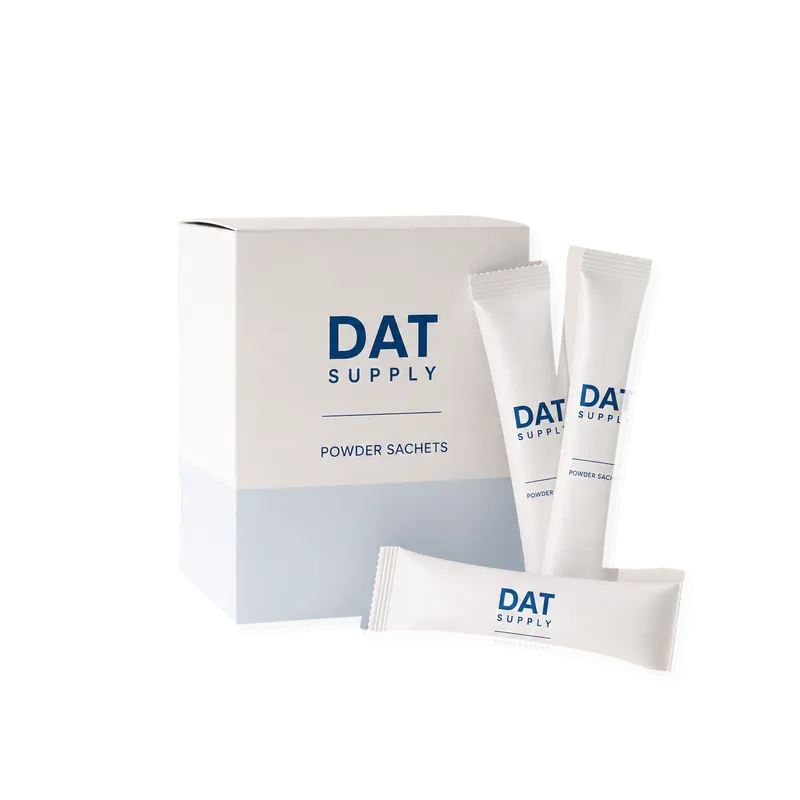
Private-label ashwagandha powder (powder format). Key actives: Ashwagandha KSM-66. Per 1 sachet. EU & US draft formula, MOQ-friendly private label.
Private-label bcaa recovery powder (powder format). Key actives: Leucine, Isoleucine, Valine. Per 1 sachet. EU & US draft formula, MOQ-friendly private label.
Private-label beetroot nitric powder (powder format). Key actives: Beetroot Extract. Per 1 sachet. EU & US draft formula, MOQ-friendly private label.
Private-label cacao adaptogen powder (powder format). Key actives: Cacao, Lion's Mane Extract, Cordyceps Extract. Per 1 sachet. EU & US draft formula, MOQ-friendly private label.
Private-label collagen powder (powder format). Key actives: Collagen Peptides, Vitamin C. Per 1 sachet. EU & US draft formula, MOQ-friendly private label.
Private-label creatine powder (powder format). Key actives: Creatine Monohydrate. Per 1 sachet. EU & US draft formula, MOQ-friendly private label.
Private-label daily multivitamin powder (powder format). Key actives: Magnesium, Vitamin C, Vitamin B3. Per 1 sachet. EU & US draft formula, MOQ-friendly private label.
Private-label eaa amino powder (powder format). Key actives: Leucine, Isoleucine, Valine. Per 1 sachet. EU & US draft formula, MOQ-friendly private label.
A brand owner shaping a sachet pack for Austrian brands usually starts with where it sells first. The Apotheke channel sits alongside a drugstore channel, grocery and a direct-to-consumer channel, and because that mix shapes pack format and unit economics, each lead channel points to a different count and price ladder for the sachet format. The choice of lead channel — pharmacy, drugstore or DTC — is the brand owner's to make, and the sachet format follows it. Because German is the working language and Austria shares German-language artwork across the DACH region, one German artwork master can travel with the pack. The cert panel commonly seen on Austria pack — V-Label, the EU organic leaf, kosher or halal where the brief requires it — is settled before the sachet format is locked.
Running the sachet lane for Austrian brands starts with language: German is the working language, in its Austrian variant, so sachet pack and carton artwork is authored in German from the outset. Because Austria carries German-language artwork compatibility shared across the DACH region, that German master extends beyond a single market rather than being rebuilt from scratch. On the regulatory side, the notifying authority is AGES, and the notification path for a supplement is a §4 LMSVG declaration via the Bundesministerium für Soziales. A brand owner planning the sachet lane treats those two points — German-first artwork and the AGES notification path — as fixed reference facts, without reading any additional ordering or precondition into them beyond what the declaration itself states.
The notifying authority is AGES. For a supplement in the sachet format for Austrian brands, the notification path is a §4 LMSVG declaration via the Bundesministerium für Soziales. Those are the authority and path exactly as given; the sachet surface does not change them.
German is the working language, in its Austrian variant, so sachet pack and carton artwork is authored in German from the outset. Austria also carries German-language artwork compatibility shared across the DACH region, so one German master can extend beyond the single market.
Private-label catalogue orders start from 1,000 units. Qualified custom development volumes are confirmed after the development scope. Final quantities are confirmed against your brief inside the portal.
Yes. Ready sample kits or development samples let you confirm format, finish and packaging before you start a full order.
Claim wording reviewed against EU 1924/2006 and 432/2012 before production.
By project stage — specification and label first, then batch-release documents and a batch-specific Certificate of Analysis after production and QC release.
Create your account, complete your company profile and brief your order inside the DAT Supply portal. Format, route and minimum order quantity are confirmed once your brief has been reviewed.