Liquid drops — dropper-format actives for daily-use and premium positioning.
Tincture, MCT-carrier and vitamin-solution drops. Active stability and carrier chemistry are reviewed per project before spec lock.
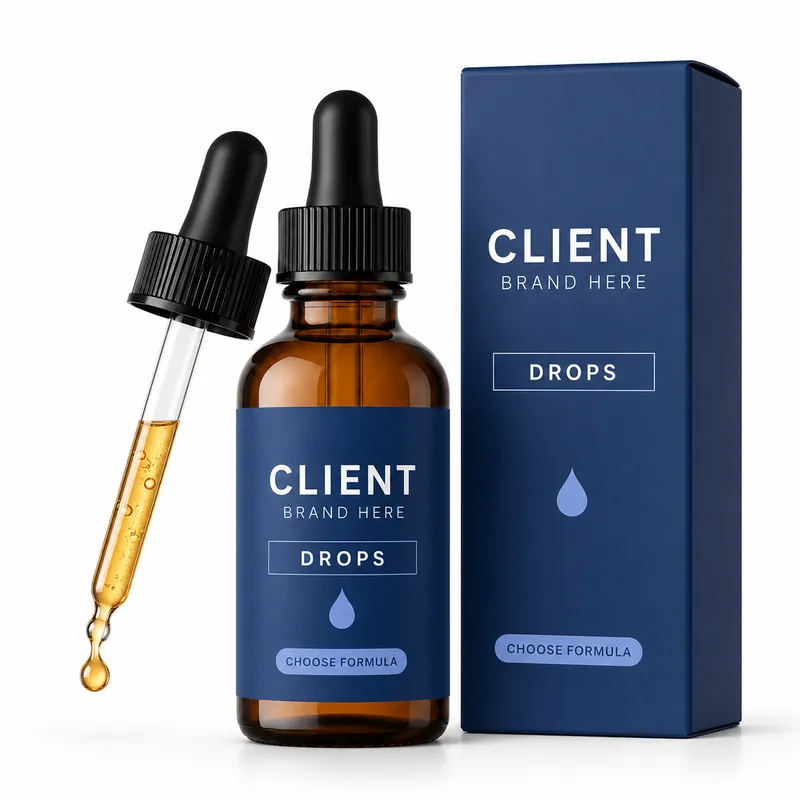
Liquid drops are reviewed per feasibility — carrier chemistry, active stability and dropper hardware are confirmed before any spec lock.
When liquid drops fit
Drops fit ranges where a sub-lingual dose, a flexible dose ramp, or a premium ritual is the brand promise. Active selection drives the carrier choice.
- Sub-lingual daily-use SKUs.
- Ranges that need a dose-titration story (start low, build up).
- Premium ritual SKUs paired with a hero range in another format.
How liquid drops are made
Liquid drops are concentrated active solutions delivered via a calibrated dropper insert. The carrier system drives the active list. MCT carriers (medium-chain triglycerides) suit oil-soluble actives — vitamin D₃, CoQ10, vitamin A, vitamin K, astaxanthin, fat-soluble botanical concentrates. Aqueous carriers with glycerin and approved preservatives carry water-soluble actives — B-vitamins, vitamin C variants, certain mineral solutions, water-soluble botanical extracts. Tincture-style ethanol or ethanol-glycerin systems carry botanical extracts at standardised ratios where the regulatory framework permits. Payload is calibrated per drop — typically 25 µL to 50 µL per drop with active concentration tuned so a daily dose lands in 5-20 drops. Dropper hardware is part of the spec: glass droppers for premium tincture positioning, polypropylene plastic droppers for cost-efficient daily-use ranges, and spray caps for travel formats. The format trades the simple "one capsule a day" ritual for a flexible dose-titration story — a brand can dial dose up or down by drop count, which fits sleep, calm, immune-support and onboarding-led routines.
Pick the option that matches the brief.
Every project moves through one of two options. Final routing is confirmed inside the portal — the option shapes the documentation set and the timeline.
Reviewed concept, your brand.
Pick a reviewed concept from the catalogue and add your brand. The fastest path from brief to launch — packaging, claims and documentation are reviewed against the target market. Project-specific packaging, flavour, colour or shape adjustments may be reviewed after order start.
- Best for
- First SKU · short timelines
- Lead time
- From 8–12 weeks
Bespoke formulation and dieline.
Fully bespoke formulation, custom flavour profile and packaging dieline for qualified 5,000+ unit projects. Available after a paid feasibility/R&D review — the right option for category-defining launches with longer planning windows and committed quantities.
- Best for
- Category-defining launch · committed quantities
- Lead time
- Final timeline is confirmed during order setup.
What each option looks like for liquid drops
Private-label is reviewed per project — the carrier and active chemistry sit inside the spec, so true private-label is typically limited to canonical reviewed concepts where the brand can adopt the spec directly. DAT confirms availability in the brief.
Custom drops development covers novel actives, premium tincture extractions, multi-active stacks within a single carrier, and specialised dropper hardware. First runs land at the 5,000-unit MOQ tier and timelines are confirmed per project after the carrier feasibility review.
Glass dropper · Plastic dropper · Spray cap
Hardware is confirmed per project — bottle, dropper insert, outer carton and child-resistant requirements are reviewed during the brief.
Drops packaging is reviewed against light, oxygen and migration sensitivity. Amber glass dropper bottles are canonical for premium tincture and oil-carrier SKUs — they protect light-sensitive actives and pair with a tamper-evident sleeve. Clear glass works for non-light-sensitive aqueous carriers and reads premium with a printed label. Plastic dropper bottles handle cost-efficient daily-use ranges, with the right polymer chosen against the carrier. Spray caps suit travel and on-the-go formats. Child-resistant requirements depend on the active (notably for melatonin-based or higher-dose vitamin D SKUs in some markets) and the outer carton, sleeve or shipper is confirmed in the brief.
- Glass dropper
Canonical premium-tincture format.
- Plastic dropper
Cost-efficient daily-use option.
- Spray cap
Travel and on-the-go ranges.
- Amber glass dropper bottle
- Clear glass dropper bottle
- Plastic dropper bottle
- Spray cap (travel format)
- Tamper-evident sleeve
- Child-resistant closure
- Premium outer carton
- On-pack QR / batch code
Reviewed concepts for this format
A short pick of reviewed concepts. Final positioning, claims and documentation are confirmed per project.
-
Daily wellness drops
Broad-spectrum daily-use drop ritual.
-
Sleep tincture
Evening ritual drop with botanical actives.
Top actives for liquid drops
Ingredients commonly reviewed for this format. Open a dossier to see dose anchors, working forms and formulation notes.
Other formats in the related formats group
Adjacent manufacturing formats DAT supports across the same product family.
Common actives for this format
Frequently asked questions
Which carriers does DAT review for drops?
MCT, aqueous and glycerin carriers are routinely reviewed. Carrier choice depends on the active stability profile and is confirmed during the brief.
Is a private-label option available for drops?
Drops typically route through personalisation or custom because the formulation matrix is part of the spec. Private-label availability is confirmed per project.
What documentation review steps apply?
Brief review, spec confirmation, artwork review per the target-market framework, and batch-specific Certificate of Analysis after QC release.
What is the order of magnitude for a first run?
Personalisation starts from 2,500 units; custom development volumes are confirmed after the development scope. Final volumes are confirmed during order setup.
Continue exploring
Private-label framing, related formats and the public-ready catalogue.
- Private label
Private label liquid drops →
Reviewed concepts in this format, pivoted for the private-label brand owner. Same four-step documentation route, catalogue-led.
- Related format
Gummies manufacturing →
Pectin-based supplement gummies — the mature DAT Supply format. Used across daily wellness, beauty, sleep and kids ranges.
- Related format
Sachets manufacturing →
Single-serving sachet format for powders, granulates or compact daily-routine concepts. Configuration confirmed per project.
- Catalogue
Browse liquid drops concepts →
Every public-ready PIM concept detected as liquid drops, sorted by family for quick scanning.
Request a liquid-drop quote
Send the brief — DAT will review feasibility, frame the spec lock and route the project.